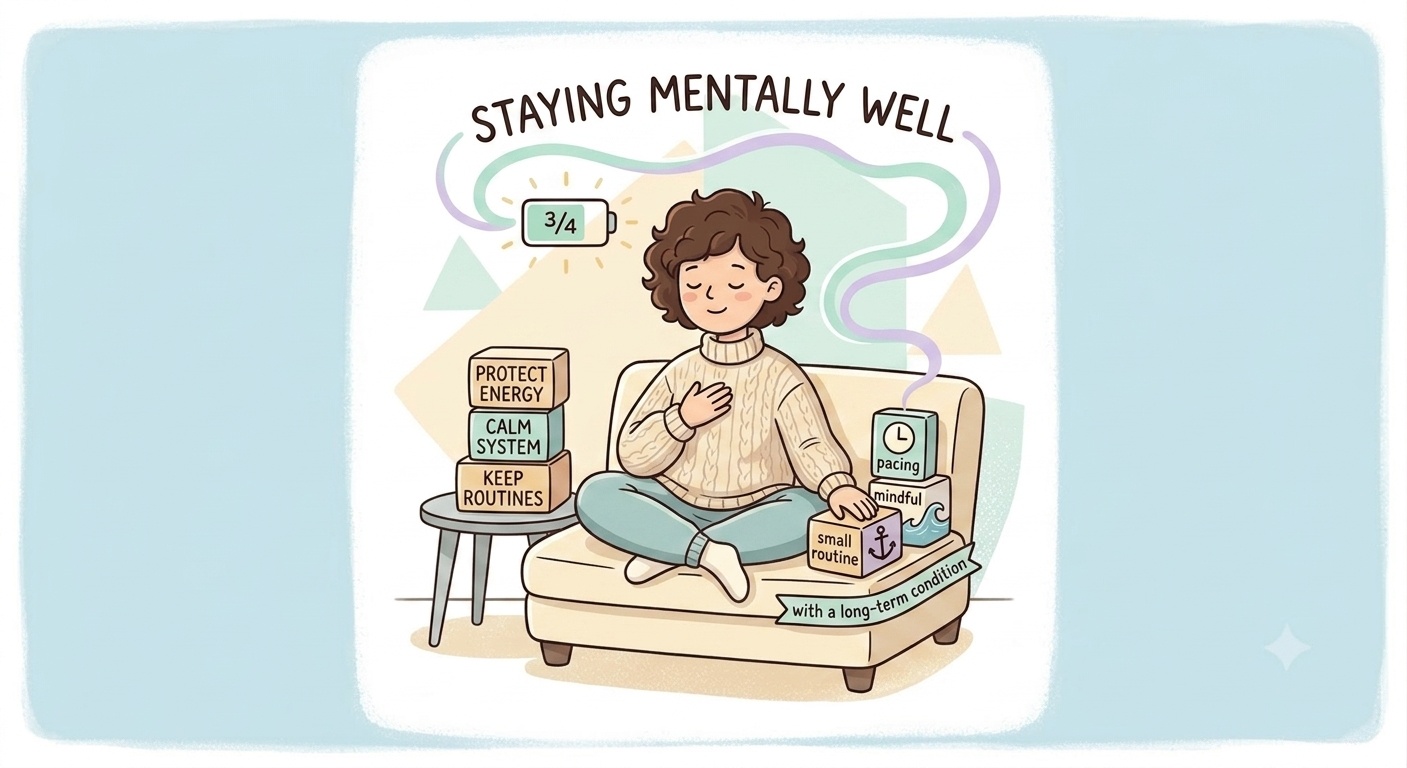
Staying Mentally Well With a Long-Term Condition
Gentle maintenance for the grief, low days and identity shifts that come with chronic illness, written as practical self-support rather than therapy.
 Written by Kim Clayden — HPD, DfSFH, MNCH, AfSFH (reg), CNHC (reg)
The mental load nobody warns you about
Living with a long-term condition means managing more than symptoms. There is the grief of the life you expected, the frustration of plans cancelled, the slow shift in identity, and the loneliness of a struggle most people do not see. These feelings are not a sign you are doing it wrong. They are a normal response to a genuinely hard situation.
The question is not how to make those feelings disappear. It is how to hold your mental baseline steady enough that bad days do not become bad months.
Maintenance, not fixing
Therapy can be invaluable, but much of day-to-day mental health is maintenance: small, repeated actions that keep you tethered to yourself and to others. Think of it like pacing for your mood. You do not wait until you are in crisis. You build a flare version of your emotional routine too.
The practices below are deliberately low energy. They are designed for days when you cannot do much, because those are the days that matter most.
Five gentle maintenance practices
1. Name one thing that went well
Not gratitude as a performance, just one small fact: the cat sat near you, the coffee was warm, a message made you smile. Naming it interrupts the brain's bias toward scanning for threat, which chronic illness tends to amplify.
2. Keep a tiny connection
Isolation is one of the fastest routes to low mood. A single text, a brief voice note, or a quiet shared online session can be enough. The quality of connection matters more than the quantity, and it does not have to involve explaining how you are.
3. Make rest emotionally legitimate
Rest is often treated as something you earn after being productive. For chronic illness, rest is a maintenance task. Giving yourself permission, out loud or in writing, reduces the shame that turns rest into something restless.
4. Update your identity gently
It is painful to feel that your body has changed the story of who you are. One helpful shift is to separate what you can no longer do from what still matters about you. You are still a friend, a thinker, a creator, a source of warmth, even on bed-bound days.
5. Plan one small pleasure in advance
Hopelessness feeds on empty tomorrows. A planned pleasure, however small, gives the future a shape. It might be a particular tea, a short audio track, a message with a friend, or a live relaxation at a set time.
When to reach for more help
If low mood is lasting, you are losing interest in almost everything, you feel unsafe, or you are using alcohol or food to cope, please contact your GP or a mental health professional. This guide is maintenance, not treatment, and there is no shame in needing more support.
In the UK, you can self-refer to NHS talking therapies through your local IAPT service, or speak to Samaritans at 116 123 any time.
Common questions
- Is low mood a normal part of chronic illness?
- Yes. Grief, frustration and identity shifts are common responses to living with a long-term condition. They are not weakness or failure. What matters is having small, practical ways to hold your mental baseline so low days do not become a lasting slide.
- How is this different from therapy?
- This guide is about maintenance: the steady, everyday practices that support emotional wellbeing alongside any medical or therapeutic care you already have. It is not a replacement for professional mental health support if you are struggling significantly.
- What helps most when everything feels pointless?
- Connection, even tiny connection, usually helps more than motivation. A single message, a quiet shared session, or one small pleasure planned in advance can interrupt the spiral. The goal is not to feel positive; it is to feel less alone.
- Can rest really improve mental health?
- For chronic illness, genuine rest is not indulgence. A nervous system that is perpetually overstretched produces more anxiety, irritability and hopelessness. Rest that actually restores the system is a direct form of mental-health maintenance.
You don't have to do this alone
A free live guided relaxation is a small, planned pleasure you can join from bed, camera off, no talking required. Membership adds regular quiet company and gentle check-ins with Kim.