Brain Fog Management Tools
Gentle routines for chronic illness that lower cognitive load, protect your capacity, and keep the fog from swallowing your day.
 Written by Kim Clayden — HPD, DfSFH, MNCH, AfSFH (reg), CNHC (reg)
Brain fog in chronic illness is real
If you live with Long Covid, ME/CFS, fibromyalgia, hypermobility/EDS or POTS, brain fog is probably one of your most frustrating symptoms. It is a cluster of cognitive effects: slower processing, poor short-term memory, word-finding difficulty, decision fatigue, and a general sense that your brain is running through porridge.
It isn't a character flaw and it isn't fixed by discipline. It responds to the same things a tired nervous system responds to: less input, more predictability, and permission to move slower. If you are newer to brain fog and want the full picture first, our guide to what brain fog is and how to clear it covers the basics before the tools.
The four tools that do most of the work
- Reduce decisions, not tasks. Fog costs you at every decision point, not every action. A repeating weekly meal, a "uniform" set of clothes, and a fixed order for morning admin all remove decisions without removing the task. Same output, half the fog tax.
- Externalise memory. If it isn't written down, on a specific day, in a specific place, it doesn't exist. A single shared list beats five clever apps. Cross things off, the visible progress helps.
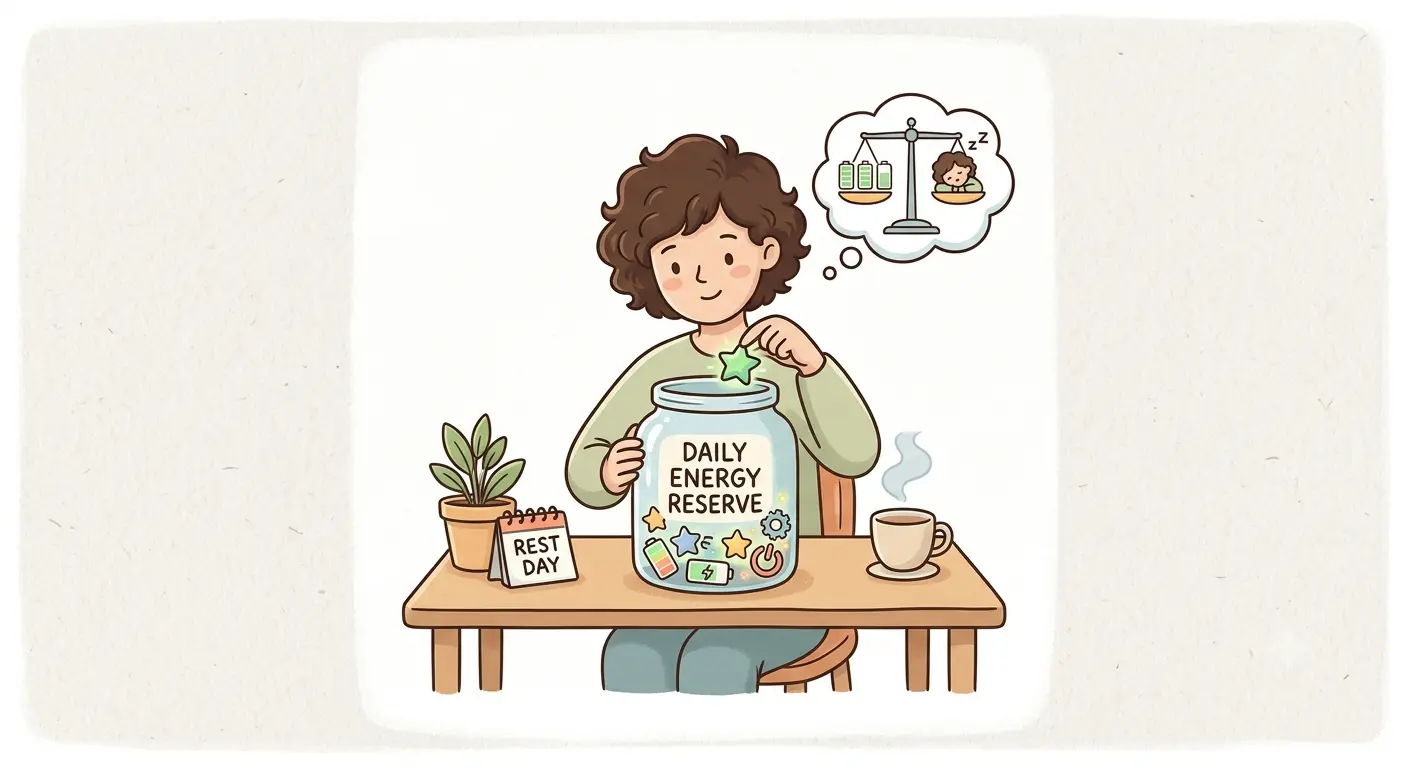
- Pace by capacity, not by clock. Instead of "I'll work for an hour", try "I'll work until I notice fog thickening, then stop". Your capacity window is real information; treating it as noise is what drives the crash.
- Build in rest as a task. Fog gets worse when rest is a reward. Put lie-down windows in the day at the same weight as the appointments, before the fog forces them.
Gentle routines for chronic illness
A "gentle routine" isn't a stripped-down productivity system. It's a small, repeating shape for the day that your nervous system can lean on without having to think about it. Three anchors is usually enough: a soft start (light, water, something warm), a middle marker (a short walk, a rest, a body-doubling session), and a wind-down (screens off, low light, something predictable).
Anchors work because they're cheap. You don't have to remember them; you just have to have them. On low-capacity days you keep the anchors and drop everything else, and you'll still land the day in roughly the right shape.
A spoonie-supportive community you can actually use on a bad day
Community helps with brain fog, but only if it's built for people who don't have spare spoons. Most "supportive" spaces expect you to introduce yourself, keep up with a thread, and pay a social cost you're already short on.
A spoonie-supportive community that works on foggy days looks more like this: turn up with your camera off, don't speak if you don't want to, drop in for ten minutes if that's all you've got, and know nobody will ask where you were last week. Presence without performance. That's what makes it sustainable.
When to ask for more help
These tools are for maintenance, not diagnosis. New or rapidly worsening cognitive symptoms deserve a GP conversation, especially if they arrive alongside numbness, headaches, vision changes, or a sudden loss of function. Brain fog management sits alongside medical care, not instead of it.
On foggy days when reading a guide is too much, you can simply lie down and follow along with a free live guided relaxation session instead, camera off, nothing to remember.
Common questions
- Is brain fog permanent?
- For most people it fluctuates with condition activity, sleep, pain and stress rather than being fixed. Reducing decisions and cognitive load usually improves day-to-day function even when the underlying condition hasn't changed. New or rapidly worsening cognitive symptoms should be checked by a GP.
- Can chronic illness affect concentration?
- Yes. Fatigue, pain, disrupted sleep, inflammation and many common medications all reduce processing speed and working memory. It is a physiological effect, not a motivation problem.
- What helps brain fog the fastest?
- Removing decisions rather than removing tasks. A repeating meal, a fixed order for admin and one written list typically free up more capacity within a day or two than any supplement or app.
- Does brain fog get worse with stress?
- Usually. A nervous system in a threat state prioritises vigilance over reflective thinking, so fog thickens under stress and eases as the system settles.
A quiet space to actually use these tools
Restful body-doubling and gentle solution-focused check-ins for people managing brain fog, fatigue and chronic illness. Start with a free live guided relaxation, camera off, nothing to remember.