Pacing Strategies for Long Covid and ME/CFS
A gentle guide to pacing for post-exertional malaise, plus fibromyalgia brain fog tools that don't require any energy you may not have.
 Written by Kim Clayden — HPD, DfSFH, MNCH, AfSFH (reg), CNHC (reg)
This guide is educational and does not replace medical advice. If you're newly diagnosed or your symptoms are changing, please speak with a medical professional familiar with Long Covid, ME/CFS or your specific condition.
Why pacing is the whole game
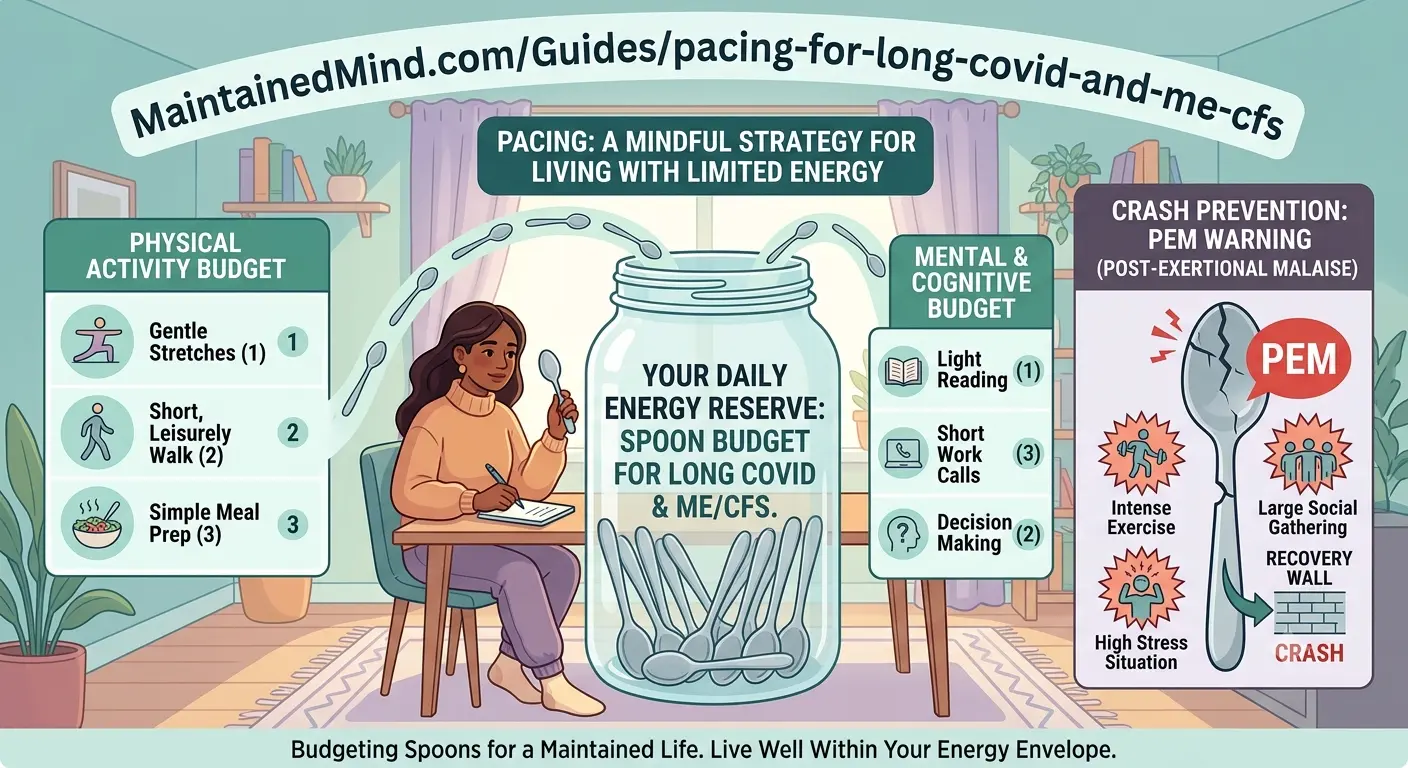
In Long Covid and ME/CFS, the defining feature is post-exertional malaise (PEM): a delayed worsening of symptoms 12–72 hours after physical, cognitive or emotional effort. PEM is not deconditioning, and it doesn't respond to graded exercise the way ordinary fatigue does. It responds to pacing, staying below your energy envelope so your body has a chance to actually recover.
Pacing sounds simple. In practice, it's the hardest self-management skill most people ever learn, because it means stopping before you feel tired. It sits at the centre of chronic illness self-management for exactly that reason.
Chronic fatigue pacing: what makes it different
Chronic fatigue pacing is not the same as "taking it easy". Ordinary tiredness improves with rest and gradually tolerates more activity. Fatigue driven by PEM behaves differently: pushing through produces a delayed penalty rather than immediate feedback, so the usual signals you would use to judge effort, arrive far too late to be useful.
That changes what pacing has to do. Instead of responding to how you feel, you work from a pre-agreed ceiling, a set amount of activity, split into short blocks, with rest scheduled between them whether or not it feels needed. Cognitive and emotional effort count against the same ceiling as physical effort, which is why a long phone call can cost as much as a walk. And the ceiling is deliberately set below your best day, because pacing to your best day is how the boom-and-bust cycle begins.
If your fatigue is due to a hypermobility syndrome, see hypermobility syndromes and energy management; if the pattern is repeated crashes, start with how to stop crashing after a flare-up.
The four core pacing skills
- Find your baseline. Your baseline is the level of daily activity you can sustain without triggering PEM. Most people find theirs by resting more than feels reasonable for a week or two and noticing what stays stable.
- Break activities into blocks. Alternate short activity blocks (5–20 minutes) with genuine rest, lying down, eyes closed, no screens. This is micro-pacing, and it protects against the invisible drain of "just one more thing".
- Rest pre-emptively. Schedule rest before predictable exertion, not after. If you know Wednesday has a phone call in it, protect Tuesday afternoon and Wednesday morning.
- Count cognitive and emotional load. An hour of admin, a hard conversation, or scrolling through medical results, all draw from the same energy budget as walking or wheeling. Pacing that ignores cognitive load is pacing that fails.
Pacing vs resting: the difference that matters
Resting is what you do when you have already overdone it. Pacing is the plan that means you overdo it less often. They feel similar from the outside, both involve lying down, but they are doing different jobs, and confusing the two is the most common reason pacing "doesn't work".
Rest is reactive and open-ended: symptoms rise, you stop, you wait. Pacing is proactive and bounded: you decide in advance how much activity a day holds, spend only that, and take rest whether or not you feel you have earned it. The uncomfortable part is that pacing means stopping while you still feel fine, the point at which every instinct says to carry on. That is precisely where post-exertional malaise happens.
A quick test: if your rest only happens after a bad patch, you are resting. If some of your rest is scheduled on a good day, you are pacing.
What a paced week actually looks like
Abstract advice is hard to act on, so here is a worked example. Imagine an energy envelope of roughly 10 "units" a day, where one unit is about 15 minutes of light activity, cognitive, emotional and physical all counted the same. The aim is not to spend all 10 every day; it is to leave a margin, and to spend less on days either side of something demanding.
| Day | Planned spend | What it holds |
|---|---|---|
| Monday | 6 units | Shower, one load of washing, 20 minutes of admin, two lying-down rests |
| Tuesday | 4 units | Deliberately light; banking energy for Wednesday's appointment |
| Wednesday | 9 units | Appointment plus travel; nothing else planned, rest before and after |
| Thursday | 3 units | Recovery day, decided in advance rather than in response to symptoms |
| Friday | 6 units | Gentle physio, a short call, one small household task |
| Weekend | 5 units each | Something restorative that costs energy but pays it back, company, craft, outside air |
Two things make this work. First, Wednesday's 9 units are only affordable because Tuesday and Thursday were dropped on purpose, pacing is a weekly budget, not a daily one. Second, the recovery day is booked before it is needed. If you wait to see how Wednesday goes, you will have already spent Thursday.
Your own numbers will differ, and finding them takes a couple of weeks of honest tracking. Start by writing down what you actually did on three ordinary days and what the following day cost you. The pattern usually appears faster than people expect, and once it does, the week above becomes something you can fill in with your own figures.
Low-capacity weeks need a smaller version of the same plan rather than no plan; the flare-up guide covers what to cut first, and self-management habits with chronic fatigue covers keeping the routine alive when the budget shrinks. On the smallest weeks, a free live guided relaxation can be the whole plan, done lying down.
Fibromyalgia brain fog tools
Fibromyalgia, ME/CFS and Long Covid all share a cognitive symptom cluster often called brain fog: word-finding trouble, short-term memory slips, and a feeling of effortful thinking. These tools reduce the cost of thinking, so you have more capacity left for living.
- One-screen rule. Close every tab, app and window that isn't the task. Switching costs more than most people realise on a foggy day.
- Externalise everything. Lists, timers, sticky notes, voice memos. Do not ask your working memory to hold anything it doesn't have to.
- Batch similar tasks. One admin block, one messaging block, one physical block. Task-switching is the most expensive thing a foggy brain does.
- Protect the first 30 minutes after waking. No screens, no news, no decisions. Brain fog is worst when you launch the day at full input volume.
- Use lie-down company. Restful body-doubling, being quietly present with others while you rest, eyes closed if you like, lets you take real rest without the isolation that often derails pacing plans.
Why pacing plans collapse alone (and how community helps)
Almost everyone who lives with Long Covid, ME/CFS or fibromyalgia has, at some point, written a beautiful pacing plan and abandoned it inside a fortnight. This isn't a willpower problem. It's a company problem. Rest that happens in isolation often stops feeling like rest, it starts to feel like being left out. That loneliness is itself an energy drain, and it quietly nudges people back into boom-and-bust.
Gentle, camera-optional group rest solves this without adding cost. You're paced, you're resting, and you're in company. The nervous system reads all three at once.
Where to go from here
Pick one skill from the four above and practise it this week. Don't try all four, that's exactly the pattern pacing is meant to interrupt.
Maintained Mind runs restful body-doubling sessions designed for people who need rest to be the task, not the reward, a gentle way to keep a pacing plan alive.
Common questions about pacing
How do I start pacing when I don't know my baseline?
Start below what you think you can manage. For a week, note what you did and how you felt the next day rather than the same day, post-exertional symptoms are usually delayed. Your baseline is the level of activity that leaves the next day unchanged, not the level you can just about survive.
Is pacing the same as resting all the time?
No. Pacing is about spreading activity so you avoid the crash, not about doing nothing. It includes planned, deliberate rest before you feel you need it, which is what keeps the good days from being borrowed from tomorrow.
Why do I keep abandoning my pacing plan on good days?
Good days feel like proof you're recovered, and the pull to catch up is strong. Most plans fail because rest is lonely rather than because it's difficult. Resting alongside other people, camera off, nothing to say, makes the plan far easier to keep.
Can pacing help fibromyalgia brain fog too?
Yes. Cognitive effort draws on the same energy envelope as physical effort, so pacing mental tasks, shorter blocks, planned pauses, one task at a time, often eases fog and word-finding difficulty as much as physical pacing eases fatigue.
How long does Long Covid last?
It varies a lot. Some people improve over a few months, while others live with symptoms for years, and many have ups and downs rather than a steady recovery. Pushing through tends to prolong crashes, so pacing within your current energy, rather than aiming for a fixed recovery date, gives your body the best conditions to settle. Your GP can refer you to a Long Covid service for assessment.
Is ME/CFS recognised as a disability in the UK?
ME/CFS can count as a disability under the Equality Act 2010 if it has a substantial and long-term effect on your ability to do normal daily activities, which it often does. That means employers and places of study must consider reasonable adjustments, such as flexible hours, rest breaks or working from home. Citizens Advice and ACAS can help you understand your rights.
Pace with quiet company
A gentle members-only space for people living with Long Covid, ME/CFS, fibromyalgia and other chronic conditions.