Low-Pressure Productivity for Executive Dysfunction
Self-compassion tools, gentle check-ins, and a neurodivergent-friendly routine you can actually keep, without turning rest into another thing you're failing at.
 Written by Kim Clayden — HPD, DfSFH, MNCH, AfSFH (reg), CNHC (reg)
Why "just try harder" makes executive dysfunction worse
Executive dysfunction isn't a motivation problem. It's a wiring pattern that makes task initiation, sequencing and switching disproportionately expensive. Effort helps some ADHD, autistic, AuDHD and post-illness brains, and completely stalls others. When you push effort into a stalled system, the usual result is shame, and shame is the fastest way to make tomorrow's start even harder.
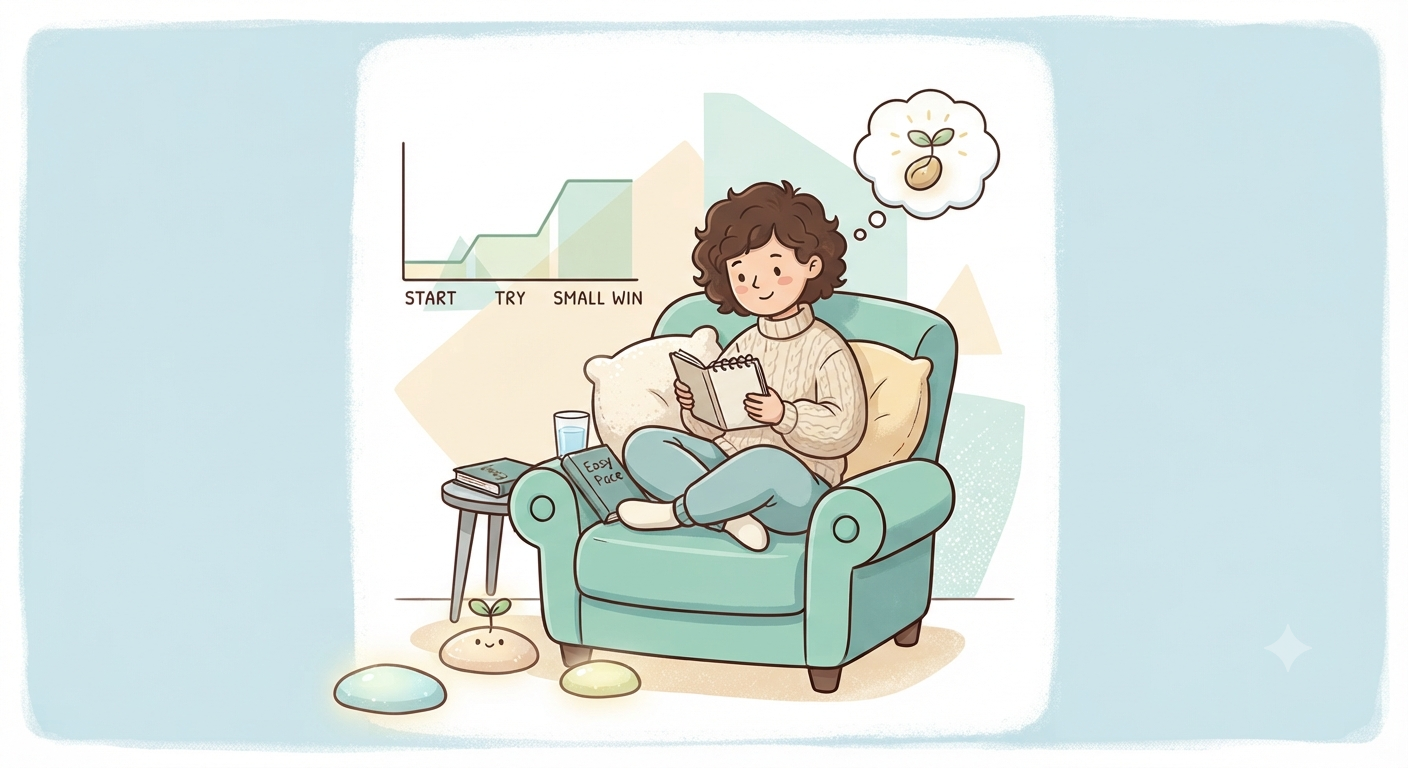
Low-pressure productivity is the opposite move. You lower the cost of starting so much that starting almost happens on its own, then you let the momentum do the rest.
How to practise low-pressure productivity
- Halve the task until it feels almost silly. "Write the report" becomes "open the document". "Tidy the kitchen" becomes "put one thing away". The smaller the ask, the less resistance the brain generates.
- Time-box loosely. Ten minutes with a soft edge. If you stop at ten, that counts. If you keep going, that also counts. Rigid timers work for some ADHD brains and shut others down; keep the option open.
- Borrow presence, not pressure. A quiet body-doubling session gives you a shared "we're doing a thing" without the anxiety of being watched. Executive function is contagious in a way that shame isn't.
- Name what worked, out loud. Solution-focused check-ins train the brain to notice small wins. "I opened the doc" is a data point, not a joke. Repeating it wires in the pattern.
- Recover on purpose. Rest isn't the reward for finishing; it's the thing that makes finishing possible next time. Put it in the plan, not the gap between plans.
Self-compassion tools for executive dysfunction
Self-compassion isn't a soft-focus mood; it's a specific set of practices that lower the internal threat level, which in turn frees up executive function. Try these:
- Third-person naming. "It makes sense that this is hard for me today" moves the moment from self-attack into observation.
- The "kind friend" test. If a friend had this exact stuck day, what would you say to them? Say that to yourself instead.
- Body-first regulation. Slow exhale, warm drink, weighted object, daylight. The brain follows the body more reliably than the other way round.
- Permission to pivot. Swapping to an easier version of the task is progress. Bailing entirely is also allowed.
Gentle mental health check-ins as a keystone habit
A gentle mental health check-in is a small, regular pause, solo or in a group, where you notice three things: what's been good, what's been hard, and what would help next. It's short on purpose. It's forward-facing on purpose. And it works partly because it happens whether or not you had a good week.
Done fortnightly in a solution-focused group, these check-ins quietly train the brain to look for what's working. That's the neuroplastic groundwork underneath every "gentle routine" you'll actually keep.
Building a neurodivergent-friendly routine
A neurodivergent-friendly routine has three qualities: predictable enough to hold you on foggy days, flexible enough to survive a flare or a hyperfocus session, and small enough that following it doesn't feel like a project. Three anchors, a soft start, a middle marker, a wind-down, is enough scaffolding for most people. Everything else is optional.
A calm place to practise this together
Restful body-doubling and fortnightly solution-focused check-ins, self-compassion tools for executive dysfunction, in a neurodivergent-friendly community.