Virtual Body Doubling for ADHD
How online focus sessions borrow another person's executive function, and why the gentlest versions work best for ADHD brains dealing with brain fog or fatigue.
 Written by Kim Clayden — HPD, DfSFH, MNCH, AfSFH (reg), CNHC (reg)
What is virtual body-doubling?
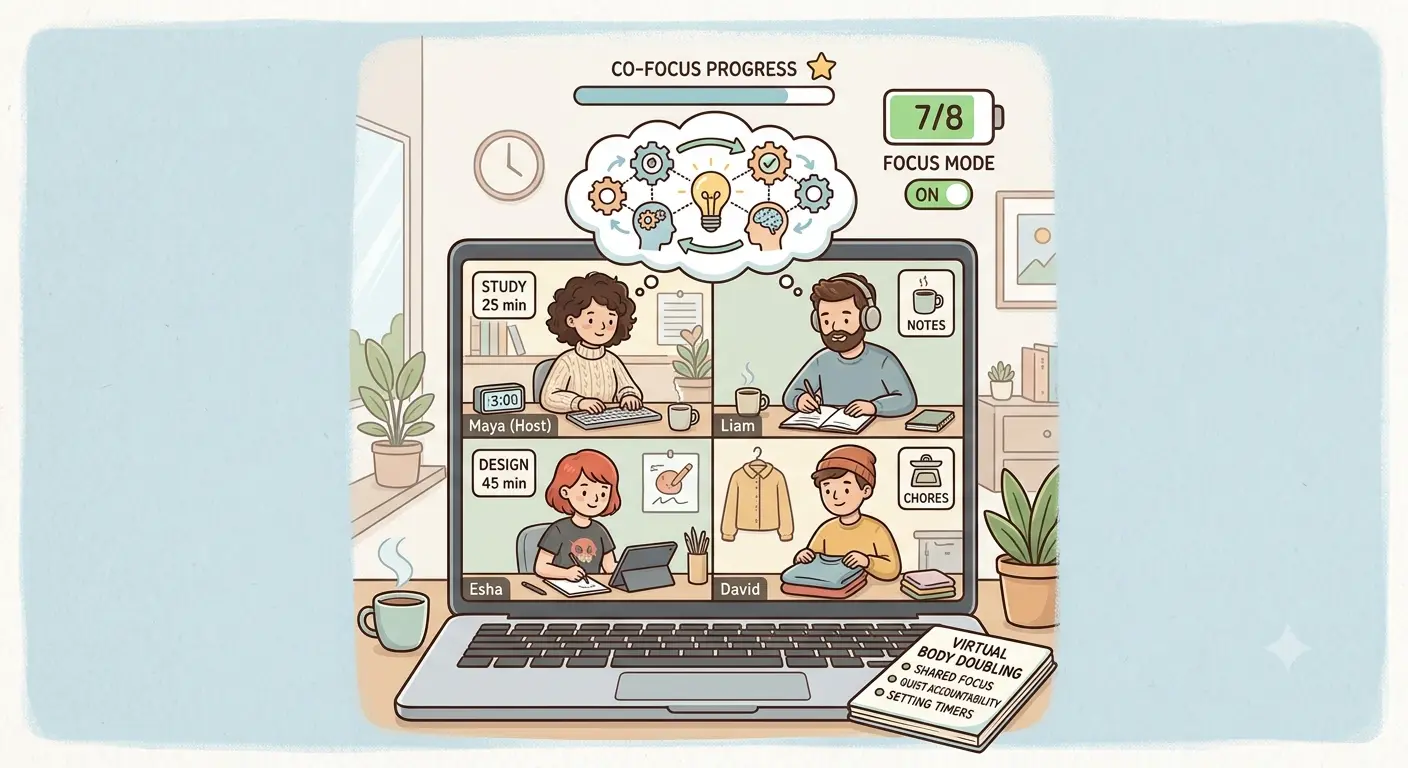
Virtual body-doubling is the practice of quietly sharing focused time with one or more other people over a video call. Nobody is helping you directly. Nobody is watching your screen. You simply work, rest, or potter alongside them, and the presence of another calm human makes it dramatically easier to start and stay with a task.
For ADHD brains, that shared presence works like a scaffold for executive function. The bit of the brain that struggles to initiate a task gets a small, steady nudge from mirror neurons: "we're doing a thing now". No pressure, no performance, no small talk required.
If pain, fatigue or sensory load means even quiet co-working is too much on a given day, the gentler variant is restful body doubling, where resting counts as taking part, and body doubling for autism and sensory overload covers the camera-off, no-introductions format in more detail.
Why body-doubling sessions help brain fog
Brain fog is not laziness and it isn't fixed by trying harder. It's the cognitive slowdown that comes with chronic fatigue, Long Covid, ME/CFS, fibromyalgia, hypermobility, perimenopause, and plenty of medication side effects. When you're foggy, decision-making costs three times what it usually does, and the "just start" step of any task becomes the hardest one.
A quiet body-doubling session removes most of that starting cost. Someone else already picked the time. Someone else opened the room. You just show up. The task shrinks to "do a bit while the session runs", and the fog has less to push against.
How virtual body-doubling for ADHD is different from Focusmate-style apps
Most online productivity groups are built for a neurotypical nervous system with plenty of energy. Camera on, verbal check-in at the start, timed sprint, verbal check-out at the end. That structure genuinely helps some ADHD brains hit a dopamine flow state, and it's brutal for anyone in burnout, brain fog, or a pain flare.
Gentler online productivity groups for chronic illness flip almost every default:
- Camera optional, usually off.
- No verbal introductions or check-ins.
- The "task" can be resting, stretching, or a physio exercise.
- You can join late, leave early, or nap through.
- Silence is the norm, not something to apologise for.
Same underlying mechanism, shared focused presence, with the sensory and social cost taken out.
Free online body doubling: what your options are
You don't have to pay to try virtual body doubling. Free options broadly fall into three groups, and they suit different days.
- Free tiers of paired apps. One-to-one matched sessions with a stranger, usually camera on and with a spoken goal at the start. Excellent for a hard start on a good-energy day; costly if you're foggy or in a flare.
- Community and Discord co-working rooms. Free and drop-in, but unfacilitated, so the tone changes with whoever is in the room and chat can pull focus.
- Facilitated free sessions. Someone holds the space, nobody has to speak, and rest counts as the task. Rarer, because someone has to run them.
Our live guided relaxations sit in that third group and are free with a Maintained Mind account, camera optional, no talking, no goal to declare. They're the gentlest way to find out whether shared presence works for your brain before you spend anything on it.
Gentle focus sessions for neurodivergents: what a session looks like
A typical restful body-doubling session runs for a fixed window, opens with a very short spoken hello (that you can skip), then settles into quiet shared time. People do washing up, admin, gentle stretching, crafts, reading, or lie down with the session running in the background. The facilitator holds the space so nobody has to perform it.
For ADHD, the value is the low-friction start. For autistic and AuDHD nervous systems, the value is the predictability. For chronically ill bodies, the value is that resting counts as a valid task.
Getting the most out of it
- Name a tiny task before you join. "Reply to one email" beats "sort out my inbox". The point is the start, not the finish.
- Let rest count. Lying down with the session on is a legitimate use of the time, especially on flare days.
- Don't chase productivity metrics. These sessions build capacity over weeks, not output over minutes.
- Return regularly. The nervous-system benefit compounds. One session is nice; a weekly rhythm quietly rewires the "starting" reflex.
Common questions
- Does body doubling work for ADHD?
- For many people with ADHD it is one of the most reliably useful strategies available. Another person's quiet presence lowers the activation cost of starting, adds mild external structure, and makes drifting away harder, without anyone supervising you.
- Does virtual body doubling work as well as in person?
- Usually yes, and often better: it removes travel, lets you leave the camera off, and makes short sessions practical. The effect comes from shared presence rather than physical proximity.
- What do I do during a body doubling session?
- Whatever you were avoiding, admin, dishes, emails, studying, or nothing at all. There is no requirement to share the task or report on it afterwards.
- What if I have ADHD and chronic fatigue?
- Choose a restful format. Sessions that open with goals and close with progress reports add a performance cost that people managing fatigue can't afford; camera-optional, rest-friendly sessions don't.
Try restful body-doubling with us
Camera-optional, low-sensory, chronically-ill-friendly online focus sessions, designed for ADHD and AuDHD brains that need rest to count as the task.