Restful Body Doubling: A Gentle Guide for Chronic Illness and ADHD
How the quiet company of others can calm your nervous system, support neuroplasticity, and help you maintain the self-management routines you already know how to do.
 Written by Kim Clayden — HPD, DfSFH, MNCH, AfSFH (reg), CNHC (reg)
What is body doubling?
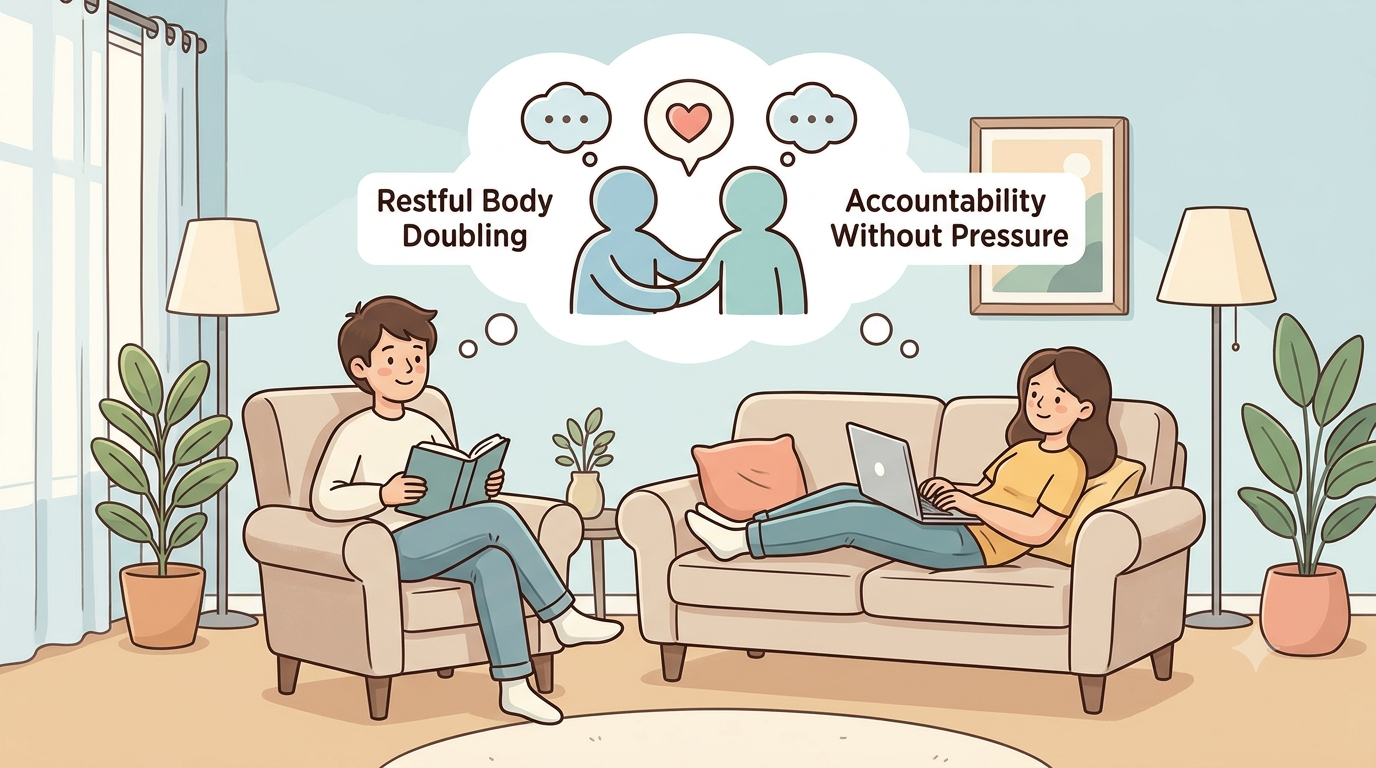
Body doubling is the practice of doing a task in the quiet, focused presence of another person, in the same room, on a video call, or even on the phone. The other person isn't there to help or supervise. They're simply present, doing their own thing, and that presence changes what your brain feels capable of.
The technique has become widely associated with ADHD as a way to start and finish tasks that otherwise feel impossible. However, for those of us living with chronic illness, long-term pain conditions, chronic fatigue, hypermobility syndromes, or nervous system dysregulation, the most useful version of body doubling looks quite different. We call it restful body doubling.
Productivity body doubling vs. restful body doubling
Most body doubling content online is framed around productivity: pushing through admin, smashing the to-do list, and beating procrastination. That framing works for some people, some of the time. However, for a chronically ill or dysregulated nervous system, "hustle energy" can quietly trigger a low-level fight-or-flight response. Cortisol rises. The window for genuine recovery shrinks. And neuroplasticity, the brain's ability to rewire toward calmer, healthier patterns, slows right down.
Restful body doubling flips the goal. Instead of using shared presence to force output, we use it to make rest, gentle self-care and small maintenance tasks feel safer and more sustainable. The "task" might be a craft project, a short relaxation or meditation practice, eating lunch slowly, or simply lying down with your camera off. If you would like to try the restful end of that spectrum first, our free live guided relaxations are open to anyone with a free login.
The neuroscience: mirror neurons and co-regulation
Humans are wired to attune to each other. Mirror neurons, cells that fire both when we do something and when we watch someone else do it, are part of how we learn, empathise, and feel safe in groups. When you sit alongside other people who are calm, focused, and unhurried, your nervous system can begin to mirror that state. Heart rate slows. Shoulders drop. Breathing deepens.
This is sometimes called co-regulation: the idea that our nervous systems regulate more easily in the company of other regulated nervous systems than they do alone. For people whose baseline tilts toward hyper-vigilance, common in chronic pain, hypermobility syndromes, ME/CFS, fibromyalgia, long COVID, EDS and similar conditions, this co-regulation can be one of the most accessible ways back into the parasympathetic "rest and digest" state.
Body doubling and ADHD: why "restful" still helps
For ADHD brains, body doubling is often described as borrowing someone else's executive function. The presence of another person provides external structure, a gentle accountability cue, and just enough novelty to help the brain start.
When ADHD overlaps with chronic illness, which it often does, the productivity framing can backfire. Boom-and-bust cycles get worse, not better. Restful body doubling keeps the executive-function benefit but lowers the stakes: the "task" is allowed to be rest, hydration, a single email, or nothing at all. The point is showing up, not output.
What a restful body doubling session looks like
A typical session is quiet, camera-optional, and structured loosely around shared presence rather than shared work. Kim might open with a brief grounding moment and name an optional gentle intention, such as "I'll be doing 10 minutes of deep breathing followed by 20 minutes of crafting" or simply "rest". You can follow her cues to change activities if you choose to, and everyone proceeds at their own pace. There's no check-in pressure, no performance, and no expectation to keep up.
- Cameras can stay off. Lying down is welcome.
- Silence is the default, chat is used sparingly.
- Leaving early, arriving late, or napping through is fine.
- The "task" can change mid-session if your body asks for something else.
Who restful body doubling is for
Restful body doubling tends to suit people who already know what helps them; they have the tools, the strategies, the crafts, and the pacing plans, but find it hard to stay consistent when flares, fatigue or brain fog make solo effort impossible. It's especially supportive for:
- Chronic illness, chronic pain, and post-viral conditions
- Hypermobility syndromes such as hypermobility spectrum disorder and EDS
- ADHD and other forms of neurodivergence
- Burnout recovery and nervous system dysregulation
- Anyone whose self-care plan tends to collapse in isolation
What is body doubling for autism?
For autistic and AuDHD people, body doubling works best when the sensory and social load is stripped out. The benefit comes from shared presence, not from cameras, introductions or check-in rounds, all of which add load rather than removing it. A quiet, camera-off room where nobody speaks gives the same co-regulation without the overload. We cover this properly in body doubling for autism and sensory overload.
Does virtual body doubling work?
Yes, for most people it works about as well as being in the same room. What matters is that another person is genuinely present at the same time, and that the session has a start and an end someone else decided. Video calls supply both. A recording does not, because the mild social pull that makes body doubling work depends on real simultaneity.
Virtual sessions also remove travel, which for a fatigued or painful body is often the difference between attending and cancelling. You can join from bed, with the screen dimmed and the camera off.
Body doubling sounds: quiet audio company
Many people search for body-doubling sounds, ambient study streams, keyboard noise, café hum, or a silent video of someone working. These help a little, because familiar low-level sound signals "someone is nearby" and softens the silence of an empty room. What they cannot supply is a real person choosing to begin at the same moment as you.
If ambient sound is what your senses can tolerate today, use it. If you want the co-regulation effect on top of it, a hosted session with the microphone muted gives you both: quiet audio company and a real, live room.
How to try it
You can start small at home: video-call a friend, mute your mics, and each do a quiet restful task for twenty minutes. Notice whether your nervous system finds it easier to settle than it does alone.
If you would rather join a room someone else has already opened, our free live guided relaxations are the gentlest starting point, cameras and microphones off throughout, free with an account.
If you'd like a ready-made, low-pressure space to practise this regularly, Maintained Mind runs restful body-doubling sessions alongside fortnightly* solution-focused check-ins, designed specifically for chronic illness self-maintenance and gentle neuroplasticity. You're welcome to join with your camera off from day one.
Common questions
- What is restful body-doubling?
- Working, resting or simply being in the quiet presence of other people, without any shared task, goal-setting or progress reporting. It keeps the co-regulation benefit of body doubling and removes the productivity framing.
- How is it different from normal body doubling?
- Standard body doubling is usually organised around output, announced goals, timers, end-of-session check-outs. Restful sessions treat presence itself as the point, so rest, lying down, or doing nothing all count.
- Do I have to have my camera on?
- No. Cameras are optional and speaking is never required. Many members join with the camera off and the session simply running in the background.
- Who is it for?
- People managing chronic illness, fatigue, pain, brain fog, ADHD, autism or post-therapy isolation, anyone for whom conventional accountability adds more pressure than it removes.
- Does virtual body doubling work as well as in person?
- For most people, yes. What matters is that another person is genuinely present at the same time and that the session has a start and end someone else decided. Video calls supply both, and remove the travel cost that often decides whether a fatigued body attends at all.
- Do body-doubling sounds and study streams help?
- A little. Ambient sound softens the silence of an empty room, but a recording cannot supply a real person choosing to begin at the same moment as you. A hosted session with microphones muted gives you both.
Practise restful body doubling with us
A gentle, science-grounded community for people maintaining their mental health alongside chronic illness or neurodivergence.
* Live sessions are subject to practitioner availability and exclude scheduled annual leave, bank holidays, and short-notice sickness. All session times are shown in UK time (GMT/BST).