Why Traditional Accountability Backfires With Chronic Illness
And what to use instead: gentle, pacing-aware alternatives that keep momentum without tipping your nervous system into a stress response.
 Written by Kim Clayden — HPD, DfSFH, MNCH, AfSFH (reg), CNHC (reg)
The hidden cost of "I'll hold you to it"
Traditional accountability is built for an able-bodied, predictable-energy world. You commit publicly, someone checks in, the pressure of being watched drives you to follow through. For most people that's neutral or motivating. For someone living with chronic illness, chronic pain, ME/CFS, Long Covid or ADHD-plus- fatigue, that same pressure lands very differently: as a stress signal.
The nervous system reads "I'll be judged if I don't do this" as a threat. Threat narrows attention, raises muscle tension, worsens pain, and often triggers the exact avoidance you were trying to prevent. What looks like a motivation problem is usually a safety problem.
Three reasons hustle-style accountability backfires
- It punishes variability. Chronic illness capacity swings hour to hour. Any structure that treats a missed day as a failure teaches your brain that flare days are shameful, which makes them harder to recover from.
- It confuses effort with output. A "productive" day for someone with ME/CFS might be one shower and a nap. Traditional accountability scores the output, not the effort, so you feel behind even when you did the hardest thing available to you.
- It centres the wrong witness. The witness is usually someone who doesn't share your context. Their check-in, however kind, becomes performance. Performance is exhausting.
What actually works: quiet company
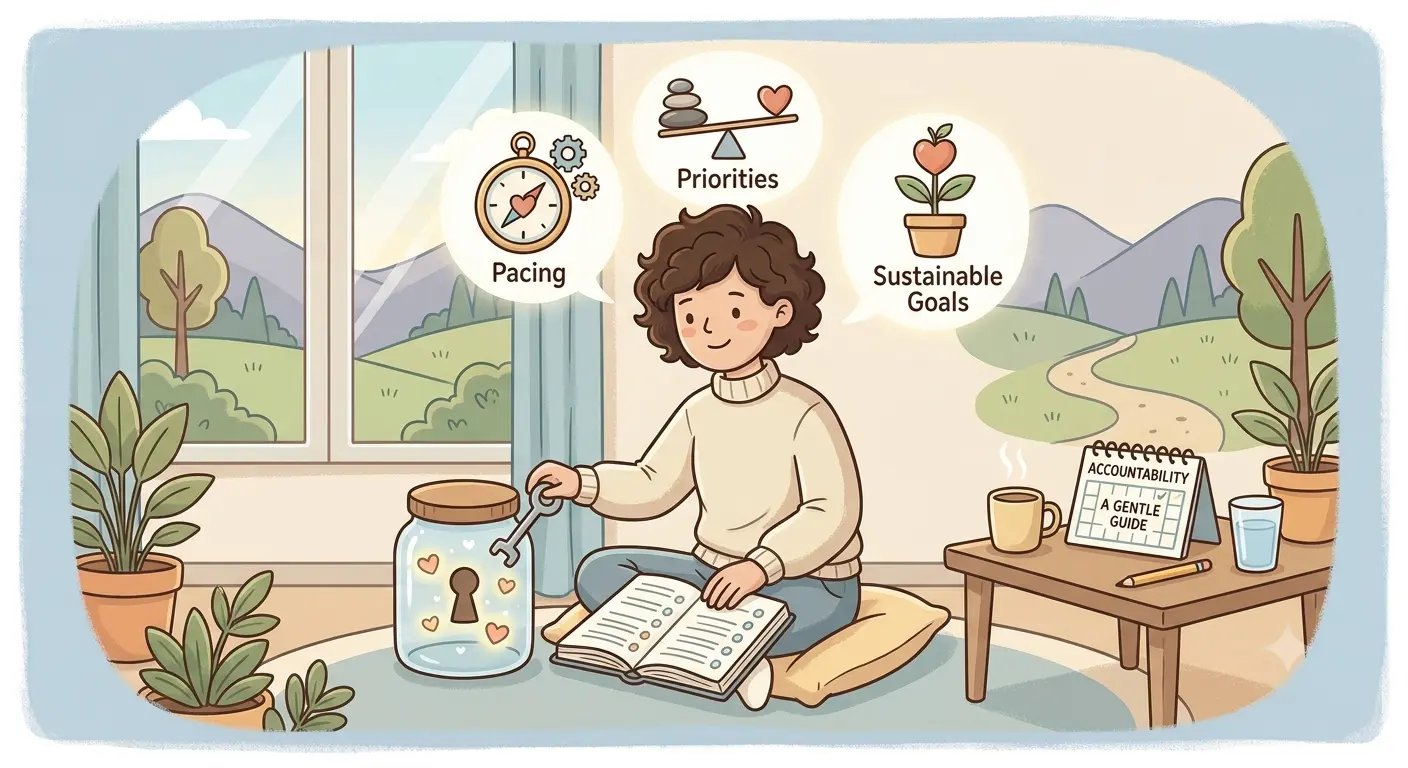
The alternative isn't no structure, it's a different kind of structure. Quiet company, also called restful body-doubling, replaces judgement with presence. You show up alongside other people, each doing your own small thing, at your own pace. Nothing is reported. Nothing is measured. The scaffolding is that someone else is also here.
This shifts the nervous system from threat to safety, which is the state in which your executive function actually works. It's why body-doubling helps ADHD, and why the gentler versions help chronic illness too.
A gentle template you can borrow
- Presence over reporting. Turn up. That's the whole contract.
- Time-boxed, not task-boxed. "I'll spend 20 minutes on admin" beats "I'll finish the tax return today".
- Flare version pre-decided. Know in advance what today's smaller version looks like, so a bad day isn't a decision.
- Solution-focused check-ins. Ask "what went well?" and "what's the next small step?" instead of "did you do it?".
If you've ever felt like accountability isn't for you
It's not that you lack discipline. It's that your body reads pressure as threat, and threat is a bad conductor for follow-through. Swap the pressure for presence and the follow-through usually returns on its own.
Maintained Mind is built around this idea: quiet company, solution-focused check-ins, and pacing that respects the day you actually have.
Company without pressure
A calm, low-stakes space to keep your maintenance strategies on track, at your pace.