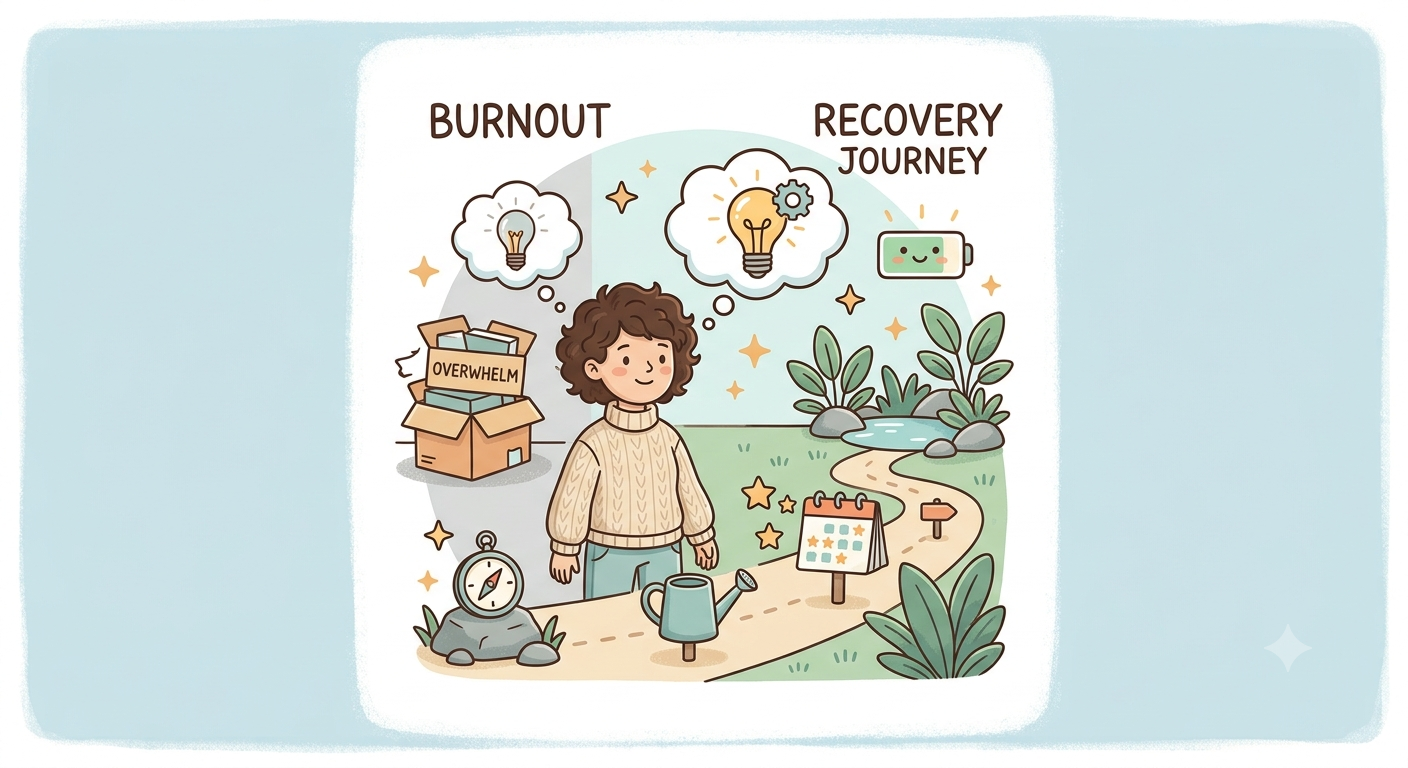
Burnout & Recovery
The early signs, why rest alone rarely fixes it, how neurodivergent burnout differs, and how to hold a baseline once therapy or sick leave ends.
 Written by Kim Clayden — HPD, DfSFH, MNCH, AfSFH (reg), CNHC (reg)
What burnout is
Burnout is what happens when demand outruns recovery for long enough that recovery itself stops working. It is not weakness and it is not simply tiredness, the defining feature is that rest no longer restores you at the rate it used to.
The signs people miss
Most people notice burnout at the collapse. The useful signals arrive months earlier. Naming them early is the whole game.
Mental and emotional signs can include:
- a shrinking tolerance for noise and interruption
- dread out of proportion to the task
- a flattening of enjoyment
- the quiet sense that you are running everything on emergency reserves.
Physical signs may include:
- frequent headaches
- muscle aches in the neck and shoulders
- more frequent colds due to weakened immune symptoms
- sleep problems like insomnia
- stomach issues.
Recovering capacity slowly
The trap in recovery is the good week. Capacity returns unevenly, and spending all of it the moment it appears is how people end up back at the start. The pacing logic used in chronic illness pacing applies almost directly, as does how to stop crashing after a flare-up.
Autistic and AuDHD burnout is different
Where occupational burnout is driven by workload, neurodivergent burnout is driven by sustained masking and sensory or executive demand. Recovery needs lower demand and fewer decisions rather than motivation, see AuDHD burnout recovery.
After therapy, sick leave or a crisis
The riskiest moment is often the one that looks like progress: the point where support stops. Read what to do when therapy ends and isolation and brain fog after therapy for how to keep a baseline in place once the scaffolding comes down.
Preventing the next one
Prevention is mostly early detection, plus a form of accountability that does not add pressure. That combination is the subject of accountability without hustle.
If you want one low-cost thing in the diary while capacity is still low, the free live guided relaxations are free with an account and ask nothing of you beyond turning up.
Guides in this topic
AuDHD Burnout Recovery
Rebuilding capacity without pushing back into burnout.
Read guideWhat To Do When Therapy Ends
Keeping hard-won strategies going once sessions stop.
Read guideIsolation & Brain Fog After Therapy
The quiet gap after therapy, and how to hold your baseline.
Read guideAccountability Without Hustle
Why traditional accountability triggers a stress response.
Read guide
Common questions
- What are the early signs of burnout?
- Usually a loss of recovery rather than a dramatic collapse: weekends stop restoring you, small tasks feel disproportionate, you become flat or irritable, sleep gets worse despite exhaustion, and things you used to enjoy feel like admin.
- How long does burnout recovery take?
- It varies widely. Mild burnout caught early can ease within weeks of a genuinely reduced load; deeper burnout, and autistic or AuDHD burnout in particular, is more often measured in months. Recovery is rarely linear, and a return of capacity is not the same as a return of resilience.
- Is rest enough to recover from burnout?
- Rest is necessary but rarely sufficient. Without changing the demands that caused it, and without rebuilding capacity gradually rather than all at once, most people cycle straight back into it.
- What is autistic or AuDHD burnout?
- A distinct state driven by prolonged masking and sensory or executive demand exceeding capacity. It typically brings reduced tolerance for stimulation, loss of skills that were previously reliable, and a need for lower-demand recovery rather than motivation.
- Why do I feel worse after therapy ends?
- Therapy provides structure, external accountability and regular contact. When it stops, all three go at once, and isolation or brain fog can surface even though nothing else changed. Building a lighter ongoing structure before the final session helps considerably.
What membership adds
- Weekly quiet co-working (restful body-doubling)
- Live check-ins with Kim (gentle, solution-focused support)
- The Quiet Corner (a wordless, zero-pressure shared pause)
- Guided Audio & Relaxation Toolkit (calming practices whenever you need a moment of ease)
- Low-Capacity Resource Library (printable tools, videos, and workshop/live event replays to explore at your own pace)