Body Doubling for Autism and Sensory Overload
Body doubling for autism works best with the camera off and the sensory bill removed. Here is why the usual productivity format overloads autistic brains, and what a quiet version looks like instead.
 Written by Kim Clayden — HPD, DfSFH, MNCH, AfSFH (reg), CNHC (reg)
What is body doubling for autism?
Body doubling for autism means doing your own task, or resting, in the quiet presence of someone else doing theirs, with the sensory and social load kept deliberately low. Autism body doubling is often described as a purely ADHD tool, but the same shared-presence effect can be deeply regulating for autistic and AuDHD nervous systems, provided cameras, introductions and check-in rounds are taken out of the format. For the underlying science, see what restful body doubling is.
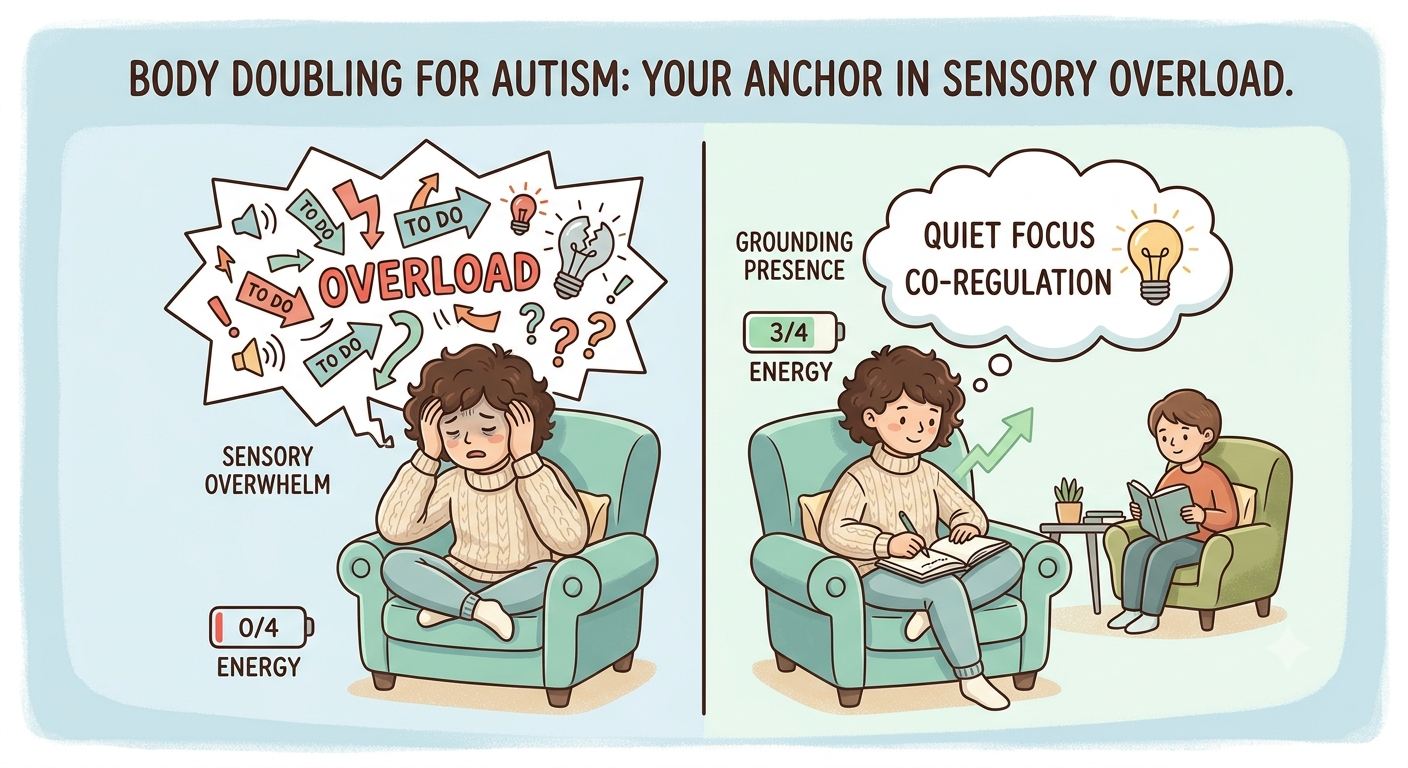
The problem is that most mainstream body-doubling spaces are built around productivity. Camera on, verbal introductions, timed sprints, chat check-ins and an unspoken pressure to perform. For someone with autism or sensory sensitivities, that format can add more load than it removes. The very thing meant to support focus becomes another source of overload.
How sensory overload shows up during body doubling
Sensory overload isn't always dramatic. It can feel like a quiet tightening: suddenly needing to mute everything, feeling unable to speak, noticing every sound in the call, or wanting to leave without knowing why. Common triggers in traditional online co-working include:
- Unexpected camera use or being watched while working.
- Verbal introductions, ice-breakers or small talk.
- Notifications, chat pings and background noise.
- Bright interface colours, moving thumbnails or sudden layout changes.
- The social expectation to explain what you've achieved.
When these stack up, the autistic nervous system can move into a protective shutdown. The session stops being helpful and starts being something to recover from.
Restful body doubling: a sensory-friendly alternative
Restful body-doubling keeps the core benefit, shared presence, while removing the parts that commonly overload autistic senses. It is designed for people who need company without performance, structure without noise, and predictability without rigidity.
- Camera optional, usually off. You can be present without exposing your space, your face, or your energy level.
- No verbal check-ins required. Sessions open quietly and settle into shared silence. Chat is available but not expected.
- Sensory defaults are low. Facilitators keep microphones muted, movement minimal, and visual clutter reduced.
- Rest counts as a task. Lying down, stimming, or simply being in the room are valid ways to participate.
- You can join late, leave early, or dip in and out. The structure is held for you, not by you.
Body doubling for AuDHD: when autism and ADHD share the same brain
AuDHD brings a particular tension. The ADHD side benefits from external accountability and shared momentum; the autistic side needs low stimulation, predictable pacing, and the freedom to opt out of social performance. A productivity-first session feeds the ADHD craving for momentum but often crashes the autistic need for safety.
Restful body-doubling resolves this by offering just enough external structure to help ADHD initiation without the sensory and social intensity that triggers autistic overload. The presence is steady rather than stimulating, and the task can be as small as "sit with the call open while I drink water."
Practical ways to make body doubling work for autism
- Preview the format before you join. Knowing what will happen, and what won't, reduces the unknown-social-load that often spikes autistic anxiety.
- Choose your sensory setup. Use headphones, dim the screen, turn off self-view, keep the camera off, and have a familiar fidget or blanket nearby.
- Define the task loosely. "Be in the room for 20 minutes" is a clearer, kinder goal than "finish the thing."
- Let yourself stim or move. Rocking, hand movements, pacing, or changing position are welcome. They are part of regulation, not distraction.
- Leave without apologising. A low-pressure session means you can exit the moment it stops feeling supportive.
Why "quiet company" can be more regulating than being alone
For autistic people who also experience isolation, especially after therapy ends or during a flare, being alone can feel safe but also lonely. Quiet company offers a middle path: enough presence to reduce the isolation signal, but not so much presence that it becomes demanding. The co-regulation is gentle, asynchronous and consent-based.
This is the difference between a body-doubling space that asks you to show up and perform, and one that simply holds a calm room you can step into. Our free live guided relaxations are the lowest-stimulation way to test that for yourself, cameras and microphones off throughout.
Common questions
- What is body doubling for autism?
- Doing your own task, or resting, in the quiet presence of someone else doing theirs, with the sensory and social load kept deliberately low. Cameras stay off, nobody introduces themselves, and no progress is reported, so you get the co-regulation without the overload.
- Is body doubling helpful for autistic people, or just ADHD?
- It began in ADHD support, but the same shared-presence effect regulates many autistic nervous systems, provided the format is quiet. The problem is rarely body doubling itself; it is the camera-on, timed-sprint, chat-heavy way it is usually run.
- What does a sensory-safe body-doubling session look like?
- A host opens the room, gives a short low-key welcome, and then it is quiet. Microphones stay muted, cameras stay off, there is no introductions round and no check-out. Stimming, lying down, moving about, or simply having the call open all count as taking part.
- Can I join if I cannot speak or turn my camera on?
- Yes. Speaking is never required and cameras are optional. Many people join with everything off and the session running quietly in the background, and leave without saying anything.
Try sensory-friendly body doubling
Start with a live guided relaxation: camera off, lying down, no introductions and no talking required, and free with an account. Membership then adds weekly low-stimulation quiet co-working and fortnightly check-ins with Kim.