Body Doubling
What it is, why it works for ADHD, autism and chronic illness, and how a restful, camera-optional version differs from productivity co-working.
 Written by Kim Clayden — HPD, DfSFH, MNCH, AfSFH (reg), CNHC (reg)
What is body doubling?
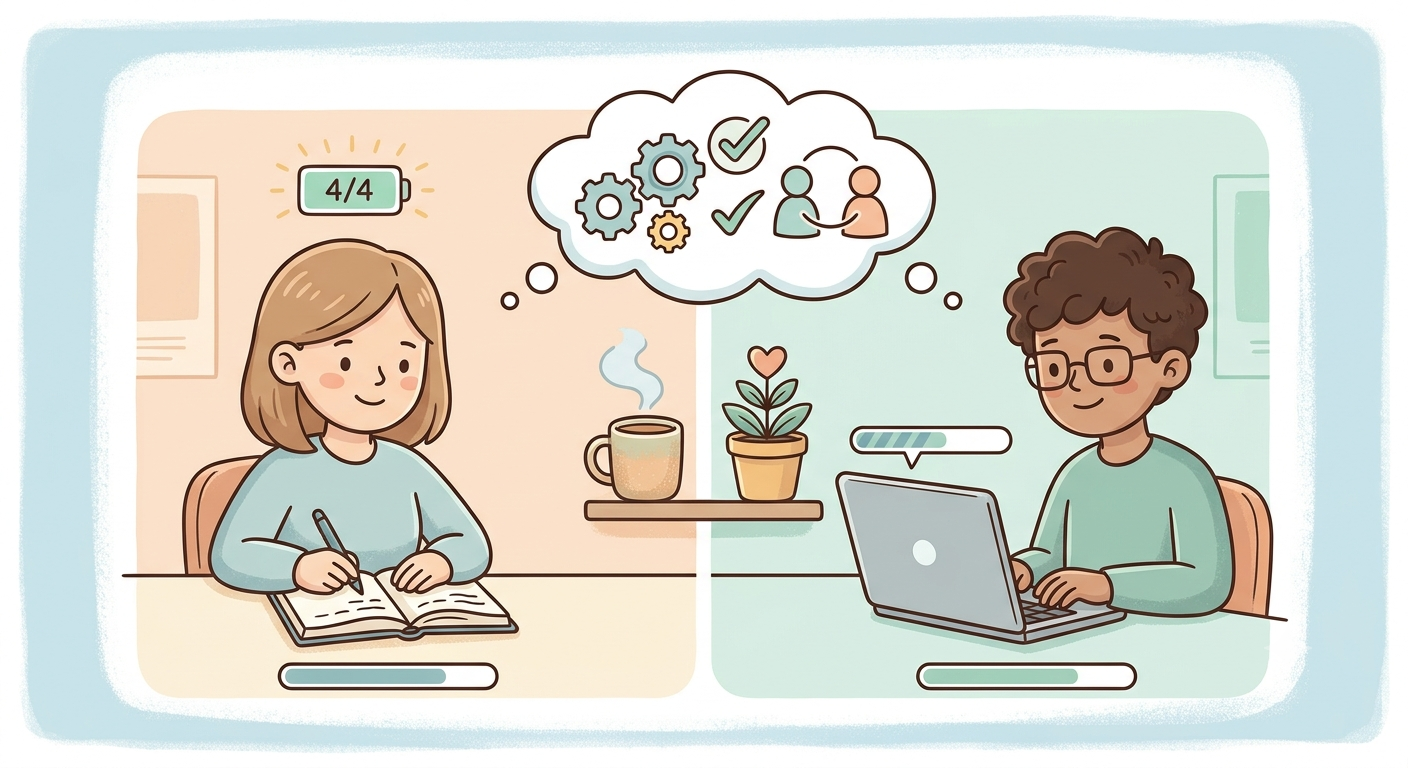
Body doubling is doing a task in the quiet presence of another person who is getting on with their own thing. Nobody instructs, supervises or shares the task, the company itself is the point. That presence supplies the small amount of structure and activation energy that was missing, which is why it is widely used for ADHD, autistic people and anyone living with fatigue or brain fog.
It can happen in person or online. Online sessions usually run on a video call where you can keep your camera and microphone off the whole time, so the only thing you share is the sense that someone else is there too.
Start with what restful body-doubling is for the co-regulation science behind it.
Body doubling for ADHD, autism and neurodivergent people
Body doubling began in ADHD support, where it is often the most reliable way to get started on something that has been sitting untouched for weeks. The mechanism is not discipline, it is borrowed momentum, which is why it keeps working on days when planners and reminders do not. Our virtual body doubling for ADHD guide covers how to set an online session up.
Autistic and AuDHD people often want the same company without the sensory load of cameras, chat and small talk. A quiet, camera-off format keeps the co-regulation and drops the parts that cost the most, see body doubling for autism and sensory overload and AuDHD burnout recovery.
Is there free online body doubling?
Yes. Maintained Mind runs free live guided relaxations online that anyone can join with a free login, no payment and no camera required. They are the restful end of the same idea, half an hour of gentle company where the only thing you have to do is be there, and past sessions stay available to watch later.
The paid membership adds the weekly quiet co-working sessions and The Quiet Corner, but you do not need it to try body doubling with us for the first time.
Why it works
Three things happen at once. Another person's calm, focused state nudges your own nervous system toward the same range, co-regulation. The session becomes a container with a start and an end, which removes the endless "when shall I do this" decision. And the mild social presence makes drifting away slightly harder without anyone policing you.
In ADHD, this substitutes for executive function you can't reliably summon on demand. In chronic illness, it substitutes for the energy that initiation normally costs.
Where productivity body doubling goes wrong
Most co-working formats open with goals and close with progress reports. If your barrier is energy rather than focus, that structure adds a performance cost to something that was supposed to reduce cost. It can also flood autistic senses with cameras, chat and small talk, see body doubling for autism and sensory overload.
Task initiation and executive dysfunction
Executive dysfunction is a starting problem far more often than a caring problem. Shrinking the first step and borrowing someone else's momentum is usually more effective than any planner, the ground covered in low-pressure productivity and accountability without hustle.
When you don't want to do anything at all
Some days the honest answer is that there is no task. That is what The Quiet Corner is for: a shared, wordless pause where presence is the whole point.
Free online body doubling: what exists and what to expect
Free options fall into three rough groups. Open video rooms, public Zoom or Discord spaces where strangers work with cameras on, are free and immediate, but unmoderated and often noisy, which is a poor fit if sensory load or social anxiety is part of the problem. Ambient study streams on YouTube cost nothing and ask nothing, but the presence is recorded rather than real, so the mild social pull that makes body doubling work is largely absent. Hosted sessions with a fixed start time are the group that actually helps most people, because someone else has already made the decision to begin.
Maintained Mind sits in that third group. The live guided relaxations are free with an account, camera-optional, and hosted, a way to try shared presence without paying for anything or committing to a productivity format. The weekly quiet co-working and The Quiet Corner sit inside membership.
Choosing the right format for the day you are actually having
The mistake is picking a format for the person you wish you were. Match it to today's barrier instead:
- You know what to do and cannot start. Silent co-working with a fixed start time. Announce nothing; just be present alongside someone.
- You start and drift within minutes. A shorter block with a visible end, and a person present for its whole length.
- You are too depleted to work but too restless to rest. A wordless shared pause, where rest is the legitimate activity.
- Noise and faces are the problem. Cameras off, chat off, microphone off, no check-in round.
- You keep overshooting on good days. A session with a hard end time, which caps the boom before the bust.
What a restful session actually looks like
People are usually surprised by how little happens. A host opens the room a few minutes early. There is a short, low-key welcome, no introductions round, no goal announcements, nobody asked to unmute. Then quiet, for a set length of time, with the group visibly present but nothing required of anyone.
In that time one person might answer two emails, another might tidy a single surface, and a third might lie down with the session running in the background. All three used it correctly. The session closes without a progress round, and nobody reports back.
When body doubling is the wrong tool
It is worth being honest about the limits. If the real problem is that a task is genuinely too big, company will not shrink it, breaking the task down has to come first. If your capacity is currently below the threshold for any activity, a co-working session can turn into another obligation you have to cancel, and rest is the better answer. And if being observed at all raises your anxiety rather than lowering it, the co-regulation effect works against you; guided relaxation on your own is a gentler starting point.
Guides in this topic
What is Restful Body-Doubling?
The co-regulation science, and how restful sessions differ.
Read guideVirtual Body-Doubling for ADHD
Borrowing another person's executive function, online.
Read guideBody Doubling for Autism & Sensory Overload
A camera-optional approach that doesn't flood the senses.
Read guideLow-Pressure Productivity for Executive Dysfunction
Task initiation without the hustle framing.
Read guideThe Quiet Corner
A shared, wordless pause; connection without speaking.
Read guideAccountability Without Hustle
Gentle follow-through that supports pacing.
Read guide
Common questions
- Does body doubling actually work?
- For many people, yes. Working in the quiet presence of someone else lowers the activation cost of starting a task, adds a mild external structure, and reduces the drift that makes tasks stall. It is widely used in ADHD coaching and is increasingly popular with people managing fatigue and brain fog.
- What is restful body doubling?
- Restful body doubling keeps the shared presence but removes the productivity goal. Nobody reports progress, cameras are optional, and rest counts as a valid thing to be doing. It suits people whose main barrier is capacity rather than motivation.
- Do I have to turn my camera on or speak?
- No. Sessions here are camera-optional and speaking is never required. You can arrive late, leave early, or simply lie down with the session running in the background.
- Is body doubling only for ADHD?
- No. It began in ADHD support, but the same co-regulation effect helps autistic people, people with executive dysfunction from any cause, and people managing chronic illness, pain or post-therapy isolation.
- How is it different from a coworking or focus app?
- Most coworking apps optimise for output, timers, streaks, goal announcements. That framing is counterproductive when your barrier is energy rather than focus. A restful format removes the performance layer and keeps only the company.
What to do next
The gentlest first step is a live guided relaxation: camera off, lying down, no talking required, and free with an account. If restful company suits you, membership adds weekly quiet co-working and fortnightly check-ins with Kim.
What membership adds
- Weekly quiet co-working (restful body-doubling)
- Live check-ins with Kim (gentle, solution-focused support)
- The Quiet Corner (a wordless, zero-pressure shared pause)
- Guided Audio & Relaxation Toolkit (calming practices whenever you need a moment of ease)
- Low-Capacity Resource Library (printable tools, videos, and workshop/live event replays to explore at your own pace)