
Hypermobility, Fatigue and Pacing
Why hypermobile bodies run out of energy faster, and gentle, joint-kind ways to keep your self-management going without paying for it later.
 Written by Kim Clayden — HPD, DfSFH, MNCH, AfSFH (reg), CNHC (reg)
Why hypermobility is so tiring
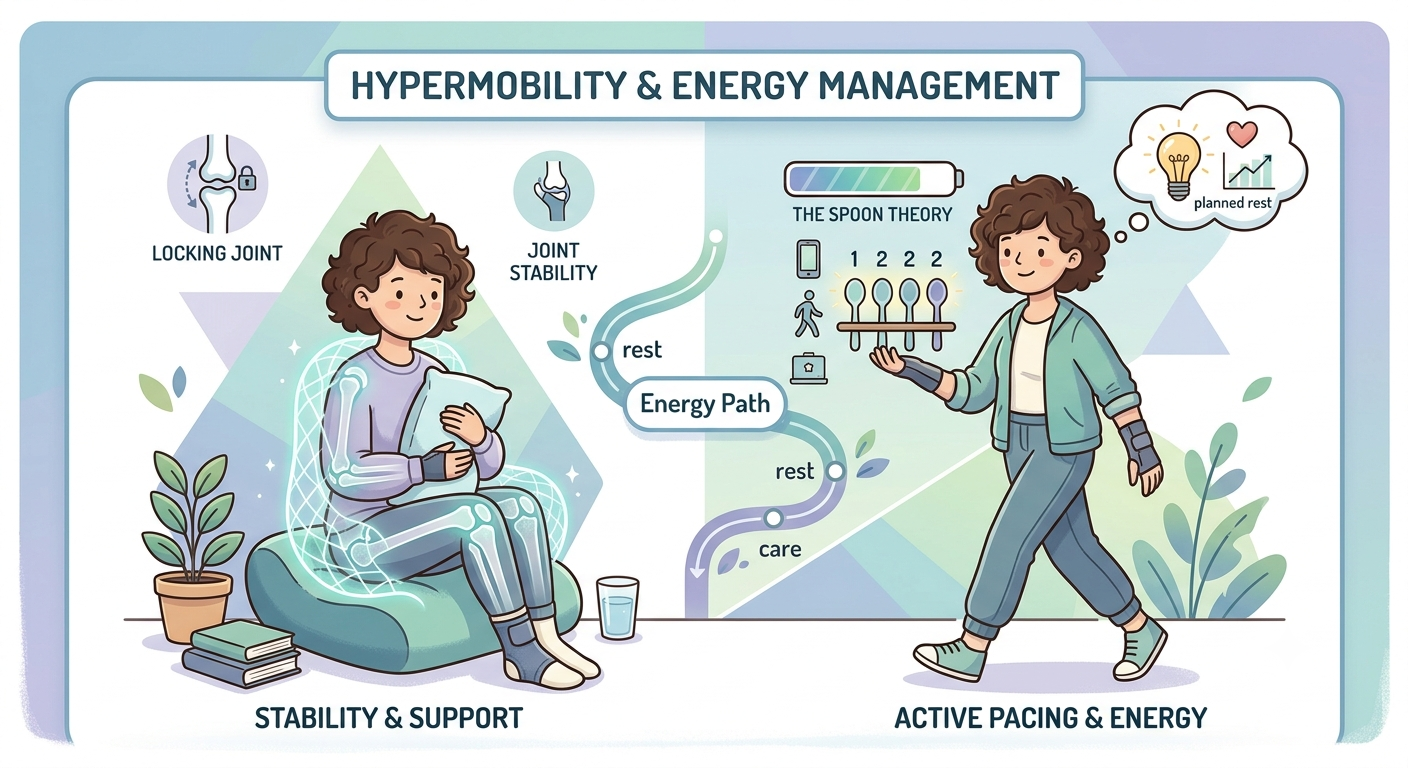
With hypermobility spectrum disorder (HSD) or hypermobile Ehlers-Danlos syndrome (hEDS), ligaments give a little more than they should. The muscles around your joints quietly take over the job of holding you together, all day, every day. That's low-grade effort you never consciously start and never get to stop, which is one reason so many hypermobile people describe a fatigue that sleep doesn't fix.
Add in the things that often travel alongside it, dysautonomia and POTS, gut symptoms, disturbed sleep, chronic pain, and brain fog, and the energy maths gets tight very quickly.
The boom-and-bust trap
On a good day, the temptation is to catch up on everything. Hypermobile bodies tend to punish that generously, often a day or two later, so the link between effort and crash isn't obvious in the moment. Over time this teaches you to fear good days, which is its own kind of exhausting.
Pacing isn't doing less forever. It's spreading effort evenly enough that your baseline stops collapsing, so the good days can slowly get more common.
Why generic exercise advice backfires
"Just build up your strength" is well-meant but incomplete. Hypermobile joints need slow, small-range, controlled loading with proprioceptive work, not intensity or big stretches. Stretching often feels wonderful and makes things worse, because your joints are already past the range they can control.
A physiotherapist who understands hypermobility will usually give you something that looks almost boringly small. That's correct. The hard part isn't the exercise, it's doing it consistently on low-energy days.
Joint-kind rest
Rest isn't automatically restorative for a hypermobile body. Slumping on a sofa for an hour can leave you sorer than you started. A few things help:
- Support the joints that are working, cushions under knees, arms, and lower back.
- Change position before you're uncomfortable, rather than after.
- Avoid end-of-range positions like sitting cross-legged or on your feet, even though they feel natural.
- Treat true rest, eyes closed, no screen, as a separate activity from "sitting down".
Have a flare version of everything
Decide now what each routine looks like at 20% capacity. Your physio set becomes two of your favourite movements. Your relaxation practice becomes one long exhale. Your weekly plan becomes one anchor. Having the small version written down means a flare-up interrupts your routine instead of ending it.
The bit nobody tells you: doing it alone is the hard part
Most hypermobile people know what they should be doing. The gap is motivation on foggy, painful days when nobody is watching and nothing feels urgent. That's exactly what restful body-doubling is for: quiet company while you do your small thing, cameras optional, no performance required.
Our members use these sessions for physio homework, gentle relaxation, or simply a guilt-free lie-down alongside other people who understand.
Common questions
- Why does hypermobility cause fatigue?
- With hypermobility spectrum disorder (HSD) or hypermobile Ehlers-Danlos syndrome (hEDS), ligaments give more than they should, so the muscles around your joints take over the job of holding you together. That is low-grade effort running all day in the background, on top of which many people also manage POTS, disturbed sleep, pain and brain fog. The result is a fatigue that ordinary sleep does not fix.
- Can hypermobility cause fatigue even on days I do very little?
- Yes. The effort is not coming from what you do, it is coming from constantly stabilising loose joints and, for many people, a nervous system that stays on alert. That is why a quiet day can still leave you exhausted, and why pacing is about spreading effort evenly rather than simply doing less.
- Does hypermobility cause fatigue that exercise can fix?
- Generic exercise advice often backfires. Hypermobile joints need slow, small-range, controlled strengthening with proprioceptive work, ideally from a physiotherapist who understands hEDS/HSD, not intensity or big stretches. The hard part is doing that small amount consistently on low-energy days, which is where gentle accountability helps.
- What helps hypermobility fatigue day to day?
- Pacing (spreading effort evenly to avoid boom-and-bust), joint-kind rest with supported positions, a written flare version of each routine, and gentle company or accountability so the plan survives bad weeks. Small, boringly consistent habits beat ambitious bursts every time.
Gentle company for the maintenance bit
Weekly restful body-doubling and fortnightly solution-focused check-ins, built for pacing rather than pushing. Start with a free live guided relaxation.
References & further reading
- Hypermobility Syndromes Association: information and support for HSD and hEDS - HMSA
- NHS: Joint hypermobility syndrome - NHS.uk
- Pacing and activity management in persistent pain - NHS.uk
This guide is educational and does not replace individual medical advice. Please consult a qualified clinician about your own health.