
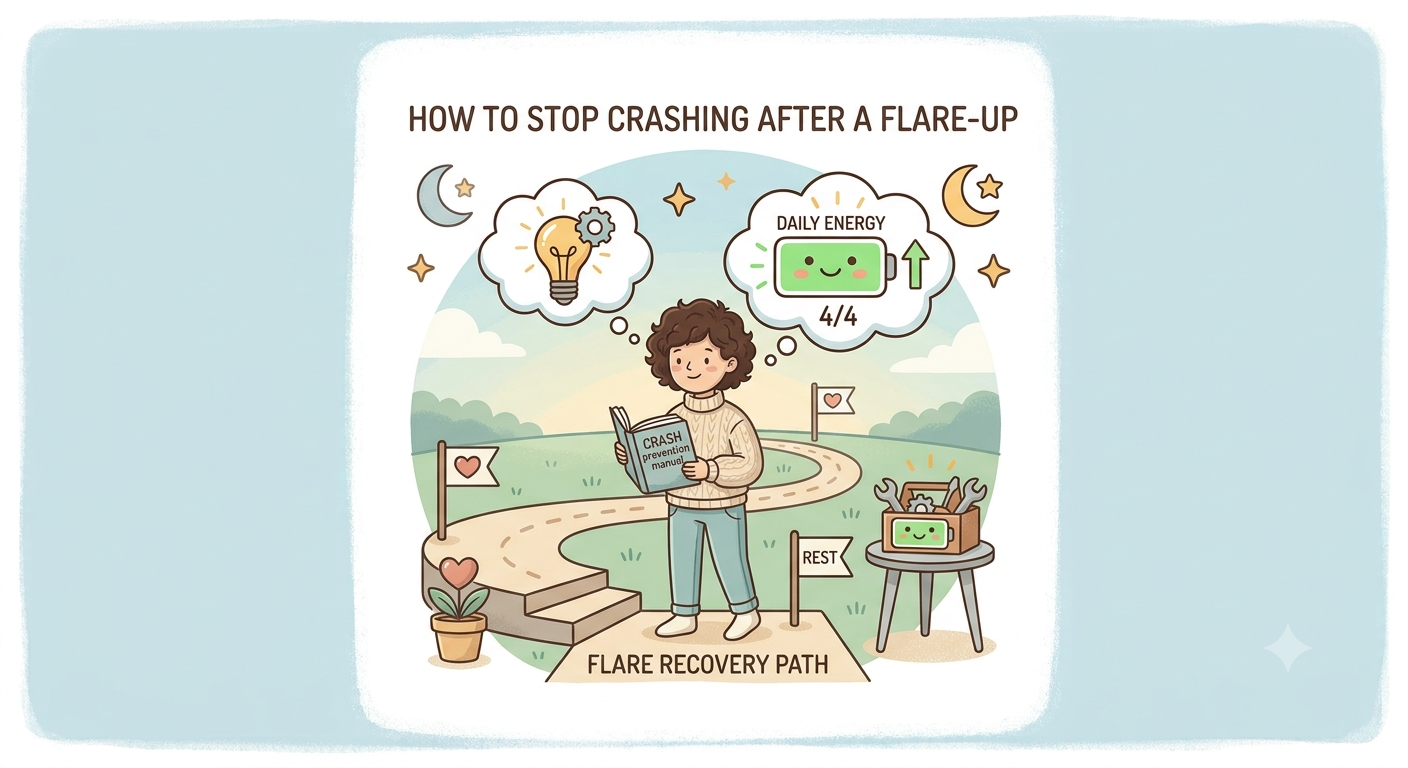
How To Stop Crashing After a Flare-Up
Why pushing through costs so much later, how to catch the early signs, and a gentler way back afterwards, without the guilt spiral.
 Written by Kim Clayden — HPD, DfSFH, MNCH, AfSFH (reg), CNHC (reg)
Why chronic illness keeps crashing after a flare-up
With ME/CFS, Long Covid, fibromyalgia, hypermobility/EDS or POTS, the pattern is familiar: you feel a bit better, do the thing you've been putting off, and a day or two later the crash arrives. Everything hurts, the brain fog rolls in, and you lose a week. Then you rest until you feel better, and the cycle starts again.
The delay is the cruel part: because the crash arrives late, your brain struggles to connect it to the effort that caused it. That's why the answer isn't willpower, it's pattern-spotting.
Learn your own early warning signs
Most people have two or three reliable tells that appear before a crash, hours before the crash itself. Common ones:
- Words start slipping, or reading the same sentence twice.
- Sounds and light feel sharper than usual.
- A specific joint or area starts aching first.
- Irritability arriving out of nowhere.
- Feeling wired and tired at the same time.
Write yours down somewhere you'll see them. On a foggy day you will not remember them, and that's exactly when they matter.
Stop at 70%, not at empty
The single most effective change most people make is finishing an activity while they still feel okay. Set a timer rather than working to a natural stopping point, because a natural stopping point in chronic illness usually means you've already overshot.
Break bigger tasks into pieces with real rest between them, eyes closed, no scrolling. Ten minutes of genuine rest is worth more than an hour of half-rest.
Build a flare version of your routine
Decide in advance what your routine looks like at 20% capacity, and write it down. One anchor, not five. A single long exhale instead of a full relaxation. A text to one person instead of a social plan. The point is that a flare-up interrupts your maintenance rather than ending it, so there's much less to rebuild afterwards.
Coming back after a crash
- Wait one extra day. Return when you've felt steady for a day, not on the first good hour.
- Restart at half of what you did before. Whatever tipped you over is the level to avoid for now.
- Rebuild one thing at a time. Add a single activity back per week and watch what happens.
- Skip the post-mortem. Note what happened factually, without the self-criticism. Guilt is another energy cost you can't afford right now.
Why company helps
Pacing is lonely and largely invisible. Nobody claps for the thing you didn't do. Quiet, regular company, people who understand spoons, flares and brain fog, makes the small version of your routine much easier to keep, and takes the shame out of a bad week.
Read more on pacing strategies →
If flares tend to arrive with a spike in pain rather than only fatigue, the neuroplasticity exercises for chronic pain are the calm counterpart to this guide, two-minute practices that help the alarm settle sooner, and all of them work lying down. During a flare you can also just join a free live guided relaxation and let someone else hold the structure for half an hour.
Common questions
- Why do I crash after a good day?
- Because capacity and symptoms are out of sync. On a good day it feels safe to spend everything available, but the cost of that spending often lands 24 to 72 hours later, the delay is what makes the pattern so hard to spot.
- How do I break the boom-and-bust cycle?
- By capping good days rather than maximising them. Set a ceiling on activity in advance, stop while you still feel fine, and treat planned rest as part of the activity rather than a reward for it.
- How long does a post-exertional crash last?
- Anything from a day to several weeks, depending on the condition and how far past your limit you went. Crashes generally shorten as pacing becomes more consistent, though recovery is rarely linear.
- What should I do during a crash?
- Drop to the flare version of your routine: keep two or three anchors, drop everything else without negotiating, and reduce sensory and decision load. Return to normal activity in small increments rather than all at once.
A low-pressure place to pace alongside others
Weekly restful body-doubling and fortnightly check-ins, designed around flare days rather than good days. Start with a free live guided relaxation.
References & further reading
- NICE guideline NG206: ME/CFS: energy management and avoiding post-exertional malaise - NICE
- NHS: Ways to manage chronic pain, including pacing - NHS.uk
This guide is educational and does not replace individual medical advice. Please consult a qualified clinician about your own health.